Best Photography Spots in Australia
Why Australia Is a Photographer's Paradise
Australia occupies an entire continent, spanning tropical rainforests in the north, ancient red deserts in the center, temperate coastlines in the south, and alpine wilderness in Tasmania. That geographic diversity translates into a photographic range that few countries can match. You can shoot turquoise ocean coves at dawn, rust-colored gorges at midday, and star-saturated skies at night, all within a single trip.
The light is different here, too. Australia sits under some of the clearest skies in the Southern Hemisphere, and the low population density outside major cities means minimal light pollution for astrophotography. The golden hour lasts longer in the southern latitudes during winter, giving landscape photographers extended windows of warm, directional light.
This guide covers the locations the team at ExifGrabber considers essential for any photographer visiting Australia, organized by region. For each spot, we include the best time to visit, recommended gear, and composition tips.
As an Amazon Associate, ExifGrabber earns from qualifying purchases.
New South Wales
The Blue Mountains: Three Sisters and Beyond
,_Three_Sisters_--_2019_--_1983.jpg/1280px-Blue_Mountains_National_Park_(AU),_Three_Sisters_--_2019_--_1983.jpg)
The Blue Mountains sit just 90 minutes west of Sydney and offer some of the most accessible landscape photography in the country. The Three Sisters, a trio of sandstone pillars rising above the Jamison Valley, are the signature shot, but the real magic is in the surrounding valleys and eucalyptus forests that produce the famous blue haze the mountains are named for.
Best viewpoints: Echo Point Lookout provides the classic Three Sisters composition. For fewer crowds, walk to Pulpit Rock or head to Govetts Leap Lookout in the northern section of the park, where you can photograph Bridal Veil Falls cascading 180 meters into the Grose Valley.
When to shoot: Dawn is ideal. The valley fills with mist overnight, and as the sun rises from the east it illuminates the Three Sisters while the valley floor stays draped in fog. Winter mornings (June through August) produce the most reliable mist.
Gear recommendations: A wide-angle lens in the 16-35mm range captures the scale. A sturdy tripod is essential for low-light dawn shots. Bring a circular polarizer to cut through the haze and deepen the sky.
Composition tip: Use the eucalyptus canopy in the foreground to frame the Three Sisters and add depth. The blue haze works as a natural atmospheric perspective element, with each ridge appearing progressively lighter.
Sydney Harbour

The Opera House and Harbour Bridge together form one of the most photographed skylines on Earth, but finding a fresh angle takes some effort. The key is to move beyond the obvious Mrs Macquarie's Chair viewpoint and explore less-visited positions.
Best viewpoints: Blues Point Reserve on the north shore gives you both icons in a single frame with water reflections. Milsons Point, at the base of the bridge's north pylon, creates dramatic leading lines. For aerial perspectives, the Pylon Lookout (accessible for a small fee) offers an elevated view across the harbor.
When to shoot: Blue hour, roughly 20 to 40 minutes after sunset, is the magic window. The city lights switch on while residual color remains in the sky, and the Opera House sails glow under their dedicated lighting. Long exposures of 2 to 8 seconds smooth the harbor water into glass.
Gear recommendations: A 24-70mm or 24-105mm zoom covers most compositions. Bring a remote shutter release for long exposures. An ND filter lets you extend shutter speeds to smooth the water even at twilight.
Composition tip: Include ferries or boats as secondary subjects. The white wake lines of a ferry crossing the harbor add energy to an otherwise static skyline shot. Wait for a vessel to enter your frame before triggering the shutter.
Victoria
The Twelve Apostles and the Great Ocean Road
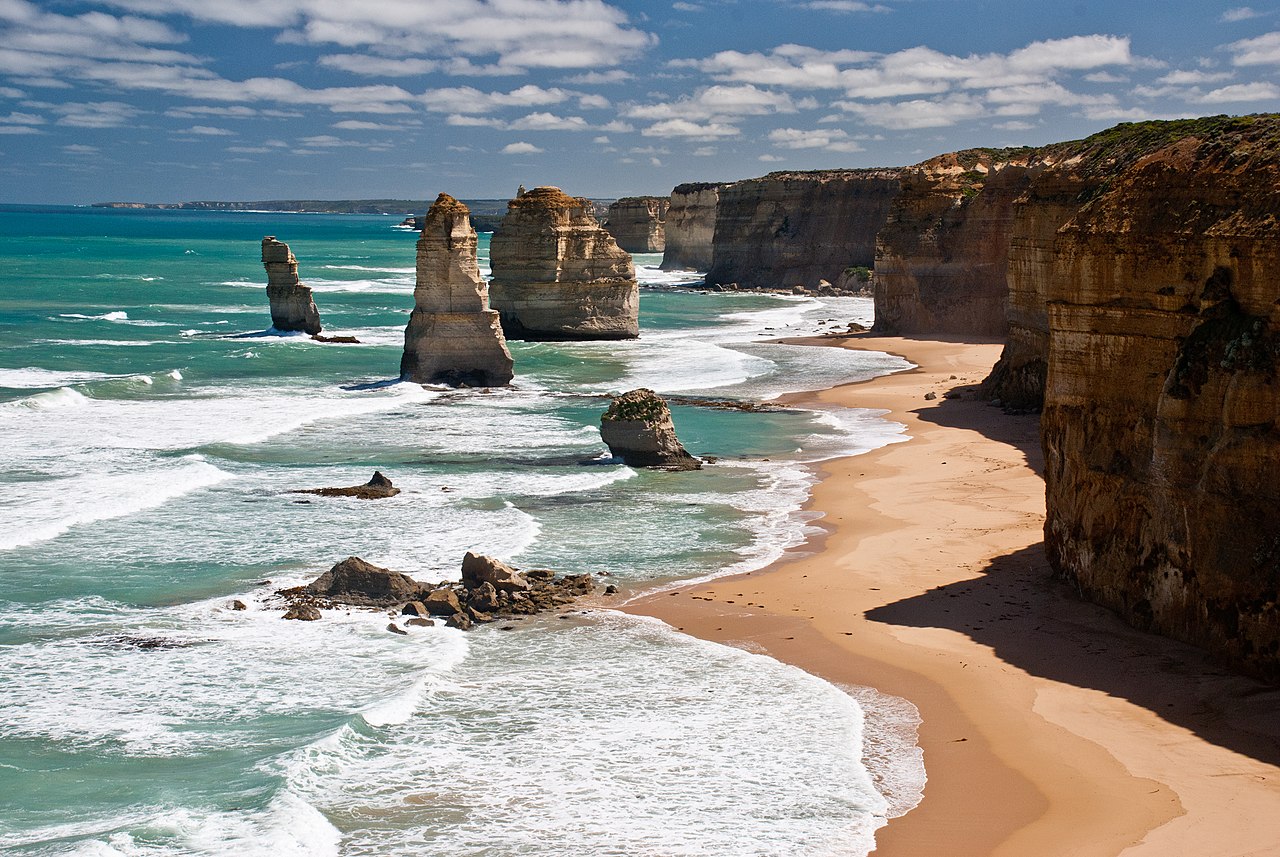
The Great Ocean Road stretches 243 kilometers along Victoria's southwestern coast, and the Twelve Apostles are its crown jewel. These towering limestone stacks, carved by millennia of Southern Ocean waves, create one of the most dramatic seascape compositions anywhere in the world.
Best viewpoints: The main viewing platform is the starting point, but the elevated helicopter viewing area (accessible on foot) offers a higher angle that separates the stacks more clearly. Loch Ard Gorge, just a few minutes' drive east, provides a sheltered cove with towering cliffs on both sides and fewer tourists. Gibson Steps beach puts you at sea level looking up at the stacks, a perspective that emphasizes their scale.
When to shoot: Sunset. The Twelve Apostles face roughly southwest, which means the late afternoon sun paints them in warm orange and gold while the ocean reflects complementary blue tones. Arrive at least an hour before sunset to set up and scout compositions. The 30 minutes around sunrise also work well, with softer, pinker light and far fewer visitors.
Gear recommendations: A 70-200mm telephoto compresses the stacks and makes them appear closer together. A wide-angle lens captures the full sweep of the coastline from the elevated platforms. A 10-stop ND filter enables long exposures that blur the ocean into misty white, creating contrast against the sharp rock formations.
Composition tip: Long exposure is the go-to technique here. A 15 to 30 second exposure at ISO 100 turns the turbulent Southern Ocean into ethereal mist that wraps around the base of the stacks. Check out our guide on how to shoot long exposures of waterfalls and moving water for technique details that apply equally well to seascapes.
Northern Territory
Uluru and Kata Tjuta
,_Uluru-Kata_Tjuta_National_Park,_Uluru_--_2019_--_3704-8.jpg/1280px-Petermann_Ranges_(AU),_Uluru-Kata_Tjuta_National_Park,_Uluru_--_2019_--_3704-8.jpg)
Uluru is Australia's most iconic natural landmark, a 348-meter sandstone monolith that changes color throughout the day. At sunrise it shifts from deep purple to burnt orange; at sunset it glows an almost impossible crimson before fading to silhouette. The nearby Kata Tjuta (the Olgas) offers domed rock formations that are equally photogenic and far less crowded.
Cultural note: Uluru is sacred to the Anangu people, and climbing it has been permanently prohibited since 2019. Certain areas around the base are also culturally sensitive and photography is not permitted. Respect posted signs and ask local guides about restricted zones before shooting.
Best viewpoints: The designated sunset viewing area on the western side provides the classic composition with flat desert foreground. For sunrise, the Talinguru Nyakunytjaku viewing area on the eastern side catches the first light hitting the rock face. The Valley of the Winds walk at Kata Tjuta offers dramatic compositions of the domed formations.
When to shoot: Sunrise and sunset are non-negotiable. The color transformation happens in a narrow 15 to 20 minute window, and the intensity depends on cloud cover. Partly cloudy skies produce the most vivid colors. Clear nights at Uluru are extraordinary for astrophotography, with Milky Way visibility from March through October. If you are interested in shooting the night sky, check our beginner's guide to astrophotography.
Gear recommendations: A 24-70mm lens covers both wide landscape and tighter detail shots of the rock's surface texture. For astrophotography, bring a fast wide-angle lens (f/2.8 or faster) and a sturdy tripod.
Composition tip: Include the desert scrubland in the foreground. Spinifex grass and desert oaks provide scale and texture that prevent Uluru from looking like a simple rock-against-sky snapshot. Use a graduated ND filter to balance the bright sky against the darker foreground.
The Devil's Marbles (Karlu Karlu)
Roughly 400 kilometers north of Alice Springs, the Devil's Marbles are a field of massive granite boulders, some precariously balanced on top of each other, scattered across a shallow valley. They are recognized internationally as some of the most striking rock formations in Australia.
When to shoot: Sunrise is the prime window. The warm morning light hits the rounded boulder surfaces while the surrounding desert floor remains in shadow, creating natural contrast. The Marbles are also excellent for astrophotography due to the remote location's near-zero light pollution.
Composition tip: Look for boulders balanced in pairs or stacks and position yourself so the rising sun appears between them. Low-angle compositions emphasize the improbable balance of these multi-ton granite spheres.
Tasmania
Cradle Mountain and Dove Lake
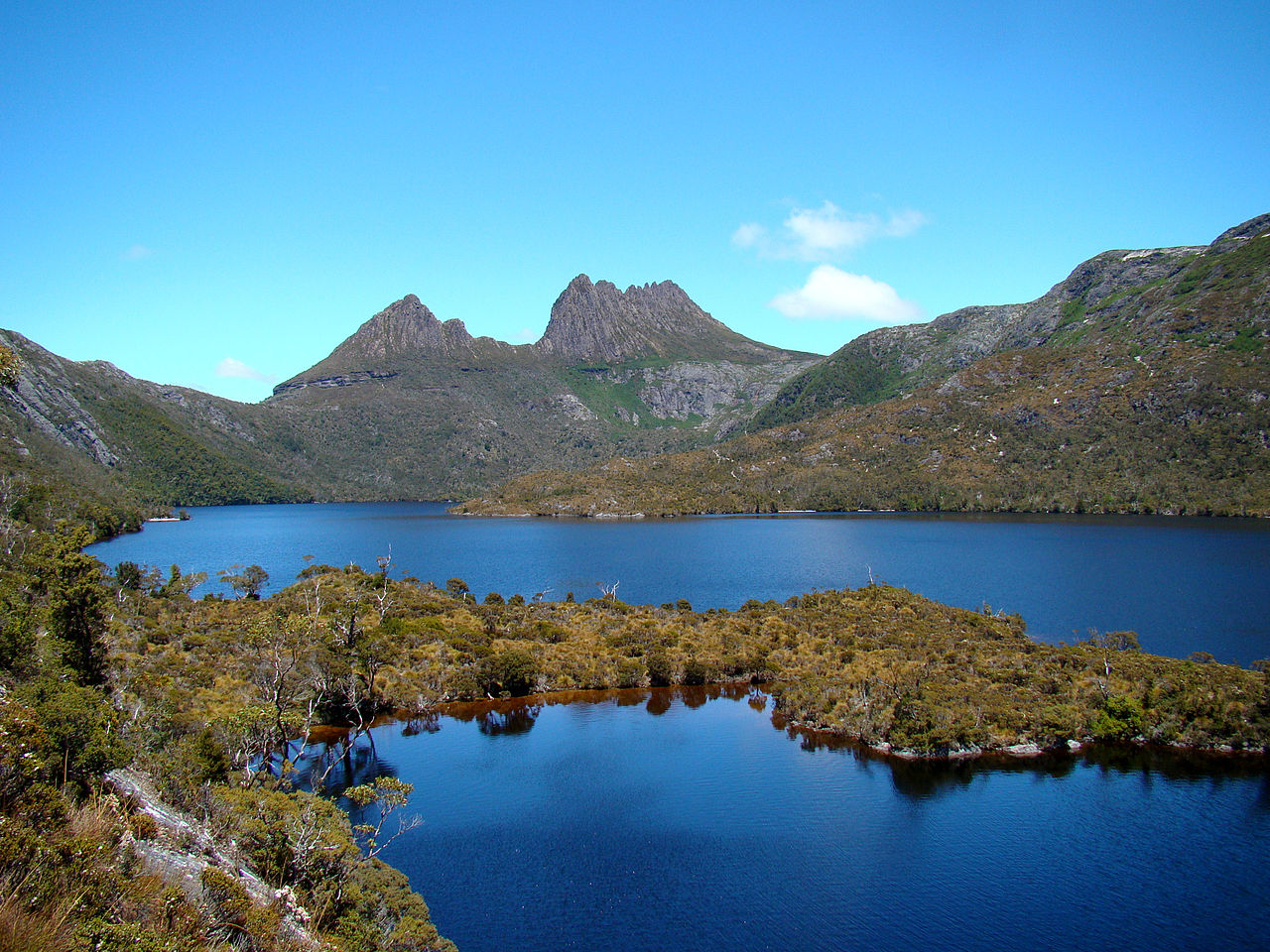
Cradle Mountain is Tasmania's most photographed mountain, and the view across Dove Lake toward its jagged peaks is one of Australia's defining landscape images. The mountain and its surrounding national park offer an incredible range of moods depending on the weather, from mirror-still reflections on calm mornings to brooding storm clouds that rake across the peaks.
Best viewpoints: The Dove Lake circuit walk (6 km, roughly 2 hours) provides multiple angles, but the most popular composition is from the eastern shore where the boathouse sits in the foreground. Marions Lookout, a steep 3-hour return hike, gives you an elevated view looking down at both Dove Lake and Crater Lake.
When to shoot: Tasmania's weather is notoriously changeable. Calm mornings (usually before 8 AM) are your best chance for mirror reflections on Dove Lake. Overcast days with low cloud create moody images as the clouds interact with the mountain peaks. Visit in autumn (March through May) for golden fagus beech foliage around the lake's edge.
Gear recommendations: A 16-35mm wide angle captures Dove Lake with the mountain behind. A graduated ND filter balances the bright sky against the darker lake. Waterproof gear is essential because Tasmania's alpine weather can shift from sunshine to rain in minutes.
Composition tip: Arrive before sunrise and set up on the eastern shore. Use the wooden boathouse as a foreground anchor, with Cradle Mountain centered in the background and reflected in the lake below. Even a slight breeze ruins the reflection, so shoot fast when conditions are still.
Bay of Fires
Tasmania's east coast hides the Bay of Fires, a stretch of white sand beaches punctuated by granite boulders covered in vivid orange lichen. The contrast between the orange lichen, white sand, turquoise water, and blue sky creates a naturally saturated palette that looks almost artificial in photographs.
When to shoot: The orange lichen glows brightest in direct morning light. Overcast conditions flatten the color. Visit between November and March for the warmest water color and longest daylight hours.
Composition tip: Get low and use a wide-angle lens to exaggerate the foreground boulders. The orange lichen is the star, so make it the dominant element in the frame. Including a small figure in the middle distance provides scale.
South Australia
The Remarkable Rocks, Kangaroo Island
Perched on a granite dome overlooking the Southern Ocean in Flinders Chase National Park, the Remarkable Rocks are a cluster of gigantic boulders sculpted by 500 million years of wind and rain into surreal, hollowed-out shapes. They look like abstract sculptures placed by a giant's hand on the edge of a cliff.
When to shoot: Sunset light entering the hollowed interiors of the rocks creates natural frames and warm glowing cavities. The Milky Way passes directly overhead during winter months, making this a stellar astrophotography location.
Composition tip: Shoot through the natural arches and windows in the rocks, using them to frame the ocean or the Milky Way. Including a person standing inside one of the formations conveys scale.
Western Australia
The Pinnacles Desert, Nambung National Park
The Pinnacles are thousands of limestone pillars rising from yellow sand dunes about two hours north of Perth. The formations range from a few centimeters to several meters tall and create an otherworldly landscape that looks more like Mars than Earth.
When to shoot: Golden hour transforms the Pinnacles. Long shadows stretch between the formations at sunrise and sunset, adding drama and depth. Full moon nights allow you to photograph the pillars bathed in moonlight with the Milky Way overhead. The location's proximity to the coast means relatively little light pollution for a spot only two hours from a major city.
Gear recommendations: A wide-angle lens captures the field of pillars stretching to the horizon. A telephoto lens (70-200mm) isolates individual formations and compresses the scene to make the pillars appear densely packed.
Composition tip: Walk deep into the formation field rather than shooting from the road or car park. Find a cluster of taller pinnacles and use them as leading elements with the sunset sky behind. The yellow sand acts as a natural reflector, bouncing warm light onto the shaded sides of the formations.
Queensland
The Daintree Rainforest
The Daintree is the oldest continuously surviving tropical rainforest on Earth, estimated at 180 million years old. It is the only place in the world where two UNESCO World Heritage sites meet: the rainforest and the Great Barrier Reef. The convergence of dense jungle and coral reef coastline creates unique photographic opportunities.
Best viewpoints: The Daintree River is best explored by boat at dawn, when mist clings to the surface and the jungle canopy reflects in the still water. Cape Tribulation beach, where the rainforest meets the ocean, offers a composition unlike anywhere else in Australia.
When to shoot: The dry season (May through October) provides more accessible trails and clearer water. The wet season (November through April) brings dramatic thunderstorms, waterfalls at full flow, and lush green canopy, but some trails and river crossings may be closed.
Gear recommendations: A weather-sealed camera body and lenses are mandatory. Humidity in the Daintree is extreme, and condensation on lens elements is a constant battle. Carry silica gel packets and a lens cloth. A macro lens opens up a world of insects, frogs, and plant details in the undergrowth.
Composition tip: Look up. The canopy is one of the most photogenic features of any rainforest, and shooting straight up through the layers of leaves with a wide-angle lens creates abstract, kaleidoscopic images.
Practical Tips for Photographing Australia
Timing your trip: Australia's seasons are reversed from the Northern Hemisphere. Winter (June through August) offers the best conditions in the Red Centre and northern tropics. Summer (December through February) is ideal for Tasmania and the southern coast. The shoulder months of April/May and September/October work well for most destinations.
Sun protection: The Australian sun is no joke. The UV index regularly reaches "extreme" levels, especially in the outback. Wear a wide-brimmed hat, apply SPF 50+ sunscreen, and carry more water than you think you will need. Protecting your gear from heat matters too: do not leave cameras in a parked car, as interior temperatures can exceed 60 degrees Celsius.
Wildlife encounters: Australia is home to some of the world's most venomous snakes, spiders, and marine creatures. Watch where you step when setting up a tripod in the bush, shake out your camera bag if you left it on the ground, and do not wade into water without checking for jellyfish or crocodile warnings.
Checking your shots: After a full day of shooting, use ExifGrabber to review the EXIF metadata from your images. Checking settings like focal length, aperture, and ISO across your best shots helps you identify which combinations worked and which to adjust for the next session.
Distances are vast: Driving times between locations in Australia are often measured in days, not hours. Plan your itinerary realistically. The drive from Sydney to Uluru is roughly 30 hours. Tasmania alone requires at least a week to cover the highlights. Internal flights (Qantas, Jetstar, Virgin Australia) are the practical way to connect distant regions.
Recommended Itineraries
One week (greatest hits): Sydney (Blue Mountains + Harbor) to Melbourne to Great Ocean Road to Cradle Mountain. This route covers coastal, urban, and alpine landscapes with manageable driving distances.
Two weeks (deep dive): Add Uluru, the Daintree, and extra time in Tasmania. Internal flights between Sydney, Alice Springs, Cairns, and Hobart connect the dots.
Three weeks (comprehensive): Add Western Australia (Pinnacles, Karijini National Park), South Australia (Remarkable Rocks, Wilpena Pound), and the Bay of Fires in Tasmania.
Australia rewards photographers who take their time. Every location on this list benefits from multiple visits at different times of day and in different weather conditions. Plan to revisit your favorite spots and let the changing light reveal new compositions.