Best Photography Spots in France: A Photographer's Location Guide
As an Amazon Associate, ExifGrabber earns from qualifying purchases.
Why France Belongs on Every Photographer's List
France is one of those rare countries where almost every region delivers something completely different to photograph. Paris gives you iconic architecture and street scenes. Provence offers rolling lavender fields and sun-baked hilltop villages. The Alps deliver dramatic mountain landscapes. Normandy has wild coastlines and one of the most recognizable landmarks on earth. The French Riviera brings Mediterranean light and color.
What makes France especially rewarding is the quality of the light. The country sits at a latitude that produces warm, golden tones in the shoulder seasons, and the varied terrain means you can shoot coastal sunrises, mountain alpenglow, and rural golden hour all within a few days' travel. When you get home, run your images through ExifGrabber to review your EXIF metadata and see exactly which settings produced your strongest frames.

Essential Gear for France
France's photographic variety means your gear choices depend heavily on which regions you plan to visit. A few universals apply regardless of destination.
A travel tripod is essential for golden hour and blue hour work at landmarks, long exposures in the Alps, and low-light shooting in lavender fields. Bring a circular polarizer to cut reflections on water and boost saturation in Provence's vibrant landscapes. If you're unfamiliar with polarizers, our guide to CPL filters covers the basics.
For lenses, a versatile zoom like a 24-70mm handles most situations. A wide-angle lens in the 14-24mm range is valuable for architecture in Paris and sweeping Alpine panoramas. A 70-200mm telephoto lets you isolate details in village scenes and compress mountain layers.
The weather varies dramatically by region and season. Pack a rain cover for your camera, especially if you're heading to Normandy or the Atlantic coast. Summer in Provence can hit 40°C, so bring plenty of water and protect your gear from heat.
Paris
The Trocadero and Eiffel Tower
The Trocadero terrace across the Seine from the Eiffel Tower is the classic viewpoint. The elevated position puts you at a slightly raised angle on the tower with the Jardins du Trocadero and its fountains spreading out below. At sunrise, you'll have the place mostly to yourself and the light comes from behind you, illuminating the tower beautifully.
Camera settings: Use f/8 to f/11 for maximum sharpness across the frame. At sunrise, you'll be shooting at ISO 200-800 depending on the light. A tripod lets you keep ISO low and use slower shutter speeds for the fountains. For blue hour, try 2-4 second exposures to capture the tower's lights reflected in still water.
Tip: The sunrise is very early in summer, often before 6 AM. This is actually an advantage because tourists are still sleeping. You'll have 30-60 minutes of clean compositions before the first crowds arrive.
Montmartre and Sacre-Coeur
The steps of the Sacre-Coeur basilica at the top of Montmartre give you a south-facing panorama across the Paris rooftops. It's one of the best elevated viewpoints in the city and completely free. The narrow cobblestone streets of Montmartre itself are excellent for street photography, with cafes, artists, and the characteristic steep staircases that define this neighborhood.
Camera settings: For the rooftop panorama, shoot at f/8 with a wide-angle lens. The compressed urban landscape looks great at 50-85mm too, isolating clusters of Haussmann-era buildings. For street scenes in the winding lanes, a 35mm or 50mm prime wide open gives you beautiful subject separation against the textured backgrounds.
Le Marais
Le Marais is one of Paris's most photogenic neighborhoods. The historic streets have a relaxed vibe, with bicycles leaning against stone walls, ivy-covered facades, and window boxes full of flowers. Place des Vosges, the oldest planned square in Paris, has beautiful red-brick arcades that frame shots nicely.
Tip: Le Marais is best photographed on foot during mid-morning or late afternoon when the narrow streets get directional sidelight. The area is compact enough to cover in a few hours of walking.
Provence
The Lavender Fields of Valensole
The Valensole plateau is the most photographed lavender region in Provence, and for good reason. Endless rows of purple stretching to the horizon, often with a lone farmhouse or tree as a focal point. The fields typically bloom from late June through mid-July, with peak color in early July. The road from Valensole to Manosque passes some of the best viewpoints.
Camera settings: Shoot at sunrise or sunset when the warm light makes the purple pop. Use f/8 to f/11 for depth of field that keeps both the foreground rows and the distant tree line sharp. A low angle with a wide-angle lens creates dramatic leading lines along the lavender rows. A graduated ND filter helps balance a bright sky against the darker field.
Practical note: It can feel like 35-40°C in the fields, and there's almost no shade. Bring plenty of water, sunscreen, and a hat. Arrive well before sunrise to set up. Renting a car is essential because there's no public transport to the fields.

Gordes
Gordes is consistently ranked among the most beautiful villages in France. It's a hilltop village in the Luberon that cascades down a cliff face, with stone buildings in warm honey tones stacked on top of each other. The classic viewpoint is from the road approaching from the east (D15), where the entire village appears perched on its rocky outcrop.
The Senanque Abbey, just a few kilometers north of Gordes, is surrounded by lavender fields and is one of the most photographed monasteries in France. The combination of the 12th-century Romanesque architecture against purple lavender rows is striking.
Camera settings: For the village panorama, use a 70-200mm from the D15 viewpoint to compress the layers of buildings. At the abbey, a wide-angle lens at f/11 captures both the building and the lavender foreground. Morning light hits the village face directly, making it the preferred time for the main viewpoint.

Gorges du Verdon
The Gorges du Verdon is often called the Grand Canyon of Europe. Cliffs rise up to 700 meters from the turquoise Verdon river below, creating some of the most dramatic landscape photography opportunities in southern France. The Route des Cretes (D23) along the north rim offers a series of viewpoints with staggering drop-offs and sweeping canyon views.
The Balcon de la Mescla viewpoint is one of the most impressive, where you can look straight down into the gorge where the Verdon and Artuby rivers meet. The water color ranges from emerald to deep turquoise depending on the season and light.
Camera settings: Wide-angle lenses (14-24mm) capture the scale of the canyon. A polarizer is essential here to cut the haze and deepen the blue-green water color. Shoot at f/11 with focus set to the hyperfocal distance for maximum depth of field. The canyon walls block direct sun in the morning, so afternoon light (3-6 PM) tends to produce the most even illumination.

Roussillon and the Ochre Quarries
Roussillon stands out from the typical Provencal palette. The village is built on ochre deposits, giving the buildings facades that range from warm yellow to deep red-orange. The Sentier des Ocres, a walking trail through the old quarry, puts you among towering ochre cliffs and pinnacles that glow in late afternoon light.
Camera settings: The intense warm tones can throw off auto white balance, so consider setting white balance manually or shooting RAW (you should always shoot RAW anyway). Afternoon light, from about 4-7 PM, brings out the richest color in the ochre formations. A 24-70mm is ideal for the quarry trail.
Normandy
Mont Saint-Michel
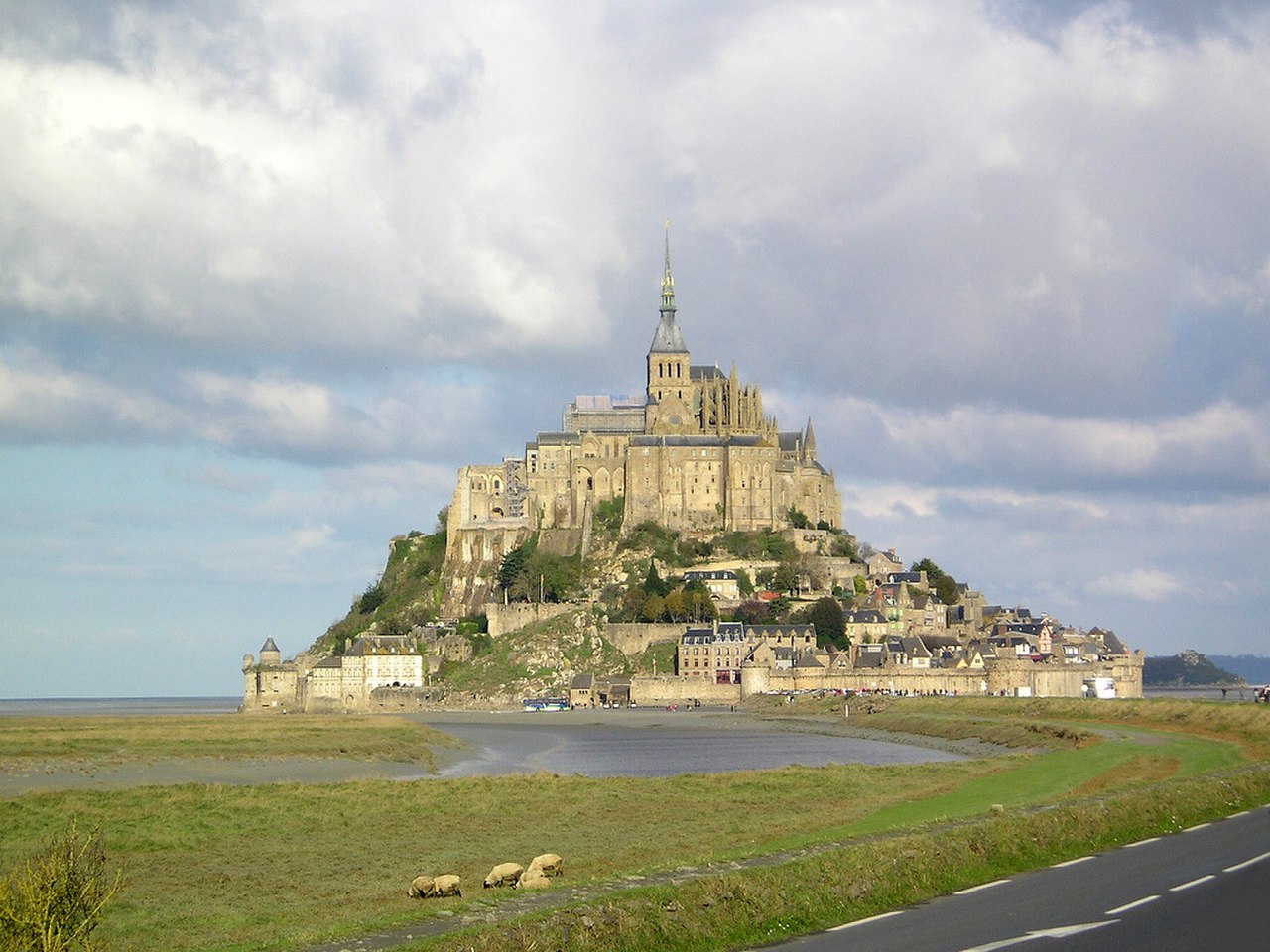
Mont Saint-Michel is one of the most recognizable landmarks in France and one of the most rewarding to photograph. The medieval abbey sits on a tidal island in the bay, connected to the mainland by a modern walkway. During high tides, the surrounding sand flats flood, and the island appears to float on the water.
The classic viewpoint is from the south, along the approach road or from the pedestrian bridge. From here, you get the full profile of the island with the abbey spire silhouetted against the sky. At low tide, the wet sand creates mirror-like reflections of the island, especially at sunrise.
Camera settings: For the classic distant view, use a 70-200mm to compress the island against the sky. At sunrise, shoot at f/8, ISO 100-400, and expose for the sky to create a dramatic silhouette. For reflections in the wet sand, a wide-angle lens at f/11 with a low angle works beautifully. A tripod is essential for blue hour and sunrise work.
Timing tip: Check the tide tables before your visit. The highest tides occur around the spring equinox (March) and autumn equinox (September), when the water can completely surround the island. These events draw crowds, but the photographic results are extraordinary.
The D-Day Beaches
The beaches of Normandy carry enormous historical weight, and photographing them requires sensitivity. Omaha Beach, with its wide expanse of sand and the American Cemetery on the bluffs above, is the most visited. The cemetery's 9,387 white marble crosses arranged in perfect rows create powerful geometric compositions.
Tip: Overcast days actually work better here than sunshine. The soft, even light suits the somber mood and eliminates harsh shadows on the headstones. Early morning visits avoid tour groups entirely.
The French Alps
Chamonix and Mont Blanc
Chamonix sits in a valley directly beneath Mont Blanc, the highest peak in the Alps at 4,808 meters. The Aiguille du Midi cable car takes you to 3,842 meters, where the panoramic views on a clear day are genuinely breathtaking. From the top, you can see the Matterhorn, the Jungfrau, and dozens of other peaks.
At valley level, the Mer de Glace glacier (accessible by the Montenvers Railway) and the reflection of Mont Blanc in Lac Blanc are iconic photography subjects. The hike to Lac Blanc takes about 2.5 hours from the Flegere cable car and is one of the most photographed trails in the Alps.
Camera settings: Mountain photography benefits from a polarizer to cut haze and deepen the sky. Shoot at f/8 to f/11 for sharpness. UV haze increases with altitude, so a polarizer does double duty here. Use a telephoto (100-400mm) to isolate individual peaks and glacial details, and a wide-angle for the sweeping panoramas from Lac Blanc.
Annecy
Annecy is often called the Venice of the Alps, and while the comparison is a stretch, the old town's canals, pastel-colored buildings, and the Palais de l'Isle (a medieval castle that sits on a small island in the Thiou canal) are genuinely photogenic. Lake Annecy itself is one of the cleanest lakes in Europe, with water so clear it reflects the surrounding mountains like a mirror.
Tip: The old town is most photogenic in early morning before the shops open. The Pont des Amours (Lovers' Bridge) gives a classic framing of the lake and mountains. Sunset from the eastern shore produces warm light on the western mountains with their reflections in the lake.
The French Riviera
Nice and the Promenade des Anglais
The sweeping curve of the Baie des Anges, with its turquoise water and the famous Promenade des Anglais, is best captured from the Colline du Chateau (Castle Hill). This elevated viewpoint on the eastern end of the promenade gives you the full panoramic sweep of the coastline with the old town rooftops in the foreground.
Camera settings: A 24-70mm covers the panoramic view nicely. The Mediterranean light is intense and contrasty at midday, so morning and late afternoon are preferred. A polarizer deepens the water color dramatically.
Eze Village
Eze is a medieval village perched on a cliff 430 meters above the sea between Nice and Monaco. The narrow stone streets, arched passageways, and the exotic garden at the summit with its cactus collection and Mediterranean views make it one of the most photogenic villages on the Riviera.
Tip: Visit on a weekday morning to avoid cruise ship crowds. The garden at the top offers unobstructed views down the coast toward Cap Ferrat.
The Loire Valley
Chateau de Chambord
Chambord is the largest chateau in the Loire Valley and one of the most architecturally ambitious buildings in Europe. The roofline alone, with its 365 chimneys, dormers, and the famous double-helix staircase visible through the windows, could keep you shooting for hours.
The grand canal in front of the chateau provides reflections at dawn and dusk. The surrounding national game reserve offers woodland backdrops in autumn colors.
Camera settings: A wide-angle lens captures the massive scale of the building. For detail work on the roofline and stonework, use a 100-400mm telephoto. The chateau faces roughly south, so morning light illuminates the entrance facade and afternoon light hits the garden side.
Chateau de Chenonceau
Chenonceau spans the Cher River on a series of arches, creating one of the most unique compositions of any castle in Europe. The view from the river's south bank, with the chateau reflected in the water, is the money shot.
Tip: The formal gardens on either side of the chateau are worth photographing from the elevated terrace. In autumn, the trees along the approach avenue turn gold and create a natural frame for the building.
Best Times to Visit France for Photography
Spring (April to June) is ideal for most of France. The weather is mild, tourist crowds haven't peaked yet, and wildflowers are in bloom across Provence and the Alps. Late June through early July is the window for lavender in Provence.
Autumn (September to November) brings warm colors to the Loire Valley, the Alps, and Burgundy's vineyards. The light has a lower angle and warmer tone that flatters architecture and landscapes alike.
Summer (July and August) is peak tourist season. Paris and the Riviera are crowded, but the long days and early sunrises give you a working window before the crowds arrive. In the mountains, summer is the only time many high-altitude trails are accessible.
Winter (December to February) is quiet and atmospheric. Paris in the rain, the Alps under snow, and the Riviera under low winter light all have their own moody beauty. Fewer tourists means cleaner compositions at popular landmarks.
Planning Your Photography Trip
Renting a car is the best way to reach many of France's finest locations, especially in Provence, Normandy, and the Alps. The autoroute network is excellent, but the scenic departmental roads (D-roads) are where the best photography happens.
For planning golden hour and sunrise times at specific locations, our guide to using PhotoPills covers everything you need. If you're new to landscape photography, brush up on composition with leading lines and negative space before your trip.
France rewards photographers who get up early. The combination of world-class landmarks, varied landscapes, and beautiful light makes it one of the most productive photography destinations in the world. Whether you spend a week in Provence or a month circling the country, you'll come home with images worth printing.