Best Photography Spots in South Korea
As an Amazon Associate, ExifGrabber earns from qualifying purchases.
Why South Korea Belongs on Your Photography Bucket List
South Korea packs an extraordinary range of subjects into a country smaller than the state of Kentucky. Ancient palaces sit in the shadow of glass skyscrapers. Neon-drenched city streets give way to terraced tea fields and volcanic coastlines within a few hours' drive. The food is endlessly photogenic, the public transport is world-class, and the light across the peninsula shifts through seasons that each bring a completely different visual character.
For travel photographers, South Korea is one of the most rewarding destinations in Asia. The country is safe, well-connected, affordable by developed-world standards, and culturally rich in a way that rewards both quick city breaks and extended road trips. Whether you shoot architecture, street, landscape, food, or portraits, there is something here for you.
This guide covers the top photography locations across Seoul, Busan, Jeju Island, and several lesser-known spots that are worth the detour. For each location, we include practical tips on timing, the best light, and gear considerations. Use ExifGrabber to check the camera settings on any travel photo that inspires you and reverse-engineer the look.
Seoul
Gyeongbokgung Palace
Gyeongbokgung is the largest and most impressive of Seoul's five grand palaces, originally built in 1395. The scale of the architecture, the saturated colors of the painted wooden structures, and the contrast between the palace grounds and the modern skyline behind them make this one of the most photographed locations in all of South Korea.
The Changing of the Guard ceremony happens daily (except Tuesdays) at 10:00 and 14:00 at Gwanghwamun Gate. It is a vivid, colorful scene that photographs beautifully from slightly above and to the side, where you can frame the guards against the gate architecture.
Inside the palace grounds, the Gyeonghoeru Pavilion, the Royal Banquet Hall reflected in its surrounding pond, is the signature shot. Arrive early in the morning for mirror-still water and soft light. The reflection shot works best at 24-35mm.
Best time: Sunrise to 9:00 AM for soft light and thin crowds. The palace opens at 9:00, but the grounds around Gwanghwamun Gate and the outer walls photograph well at dawn. Autumn (October to November) adds red and gold foliage.
Gear tip: A 24-70mm zoom covers everything from wide architectural shots to detail work on the painted eaves. Bring a polarizer to manage reflections on the pavilion pond.

Bukchon Hanok Village
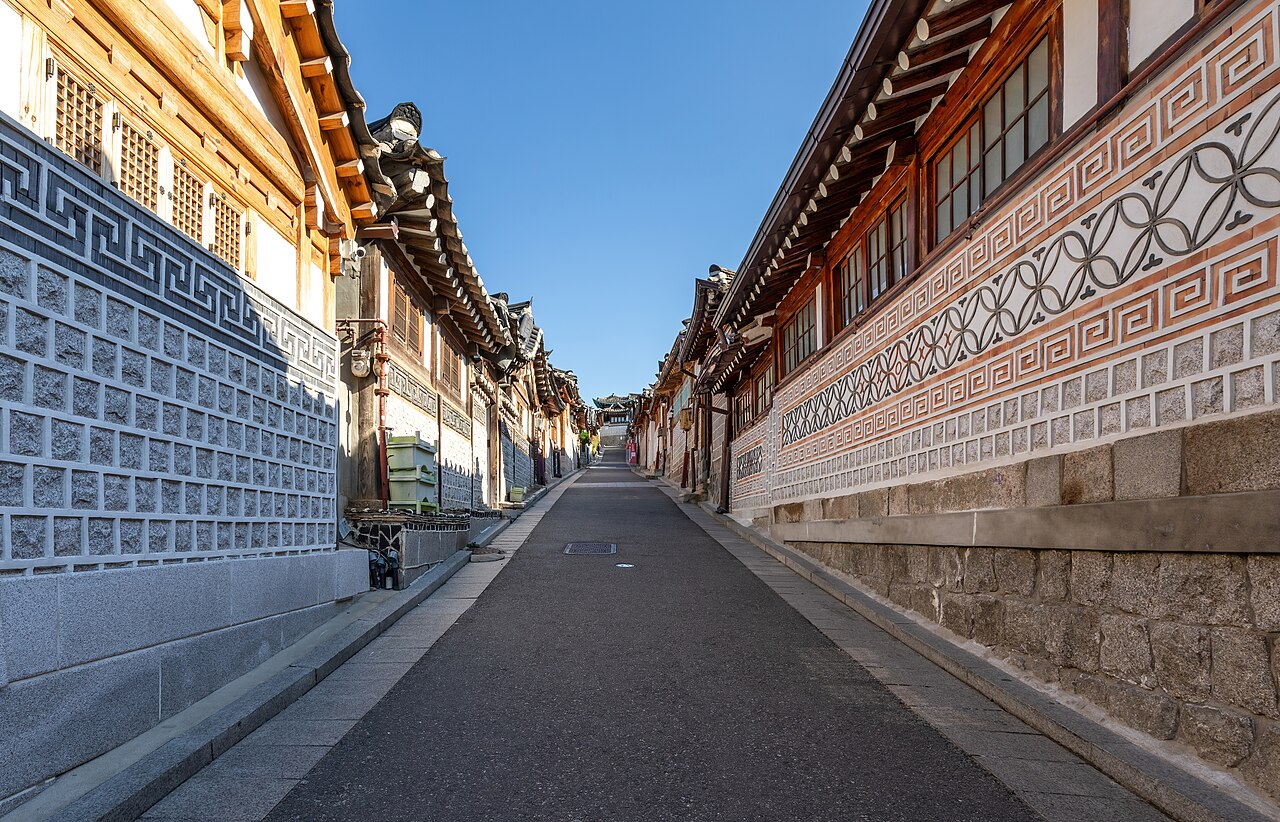
A short walk from Gyeongbokgung, Bukchon Hanok Village is a hillside neighborhood of traditional Korean houses (hanok) with curved tile roofs and wooden facades. The narrow, winding streets rise and fall over the hills between Gyeongbokgung and Changdeokgung palaces, offering layered compositions with traditional architecture in the foreground and the modern city beyond.
The most photographed street is Bukchon-ro 11-gil, a steep lane lined with hanok on both sides. It is a beautiful spot, but also one of the most crowded, and the residents have placed signs requesting quiet and respectful behavior from visitors. Keep this in mind: shoot quickly, do not block doorways, and respect the fact that people live here.
For less congested alternatives, explore the side alleys of Bukchon 1-dong and 2-dong. The rooftop cafe scene is also worth exploring. Several cafes in the area offer rooftop terraces with views across the hanok rooftops toward Namsan Tower.
Best time: Early morning (7:00-8:00 AM) before tour groups arrive. The steep east-facing streets catch beautiful morning sidelight.
Gear tip: A 35mm or 50mm prime works well in the tight streets. A telephoto (70-200mm) from the hilltop overlooks lets you compress the rooftop layers.
Changdeokgung Palace and the Secret Garden
While Gyeongbokgung gets the crowds, many photographers prefer Changdeokgung for its more intimate scale and the stunning Huwon (Secret Garden). The garden is a masterclass in Korean landscape design: pavilions mirrored in still ponds, sunlight filtering through ancient trees, and compositions that feel like stepping into a painting.
Access to the Secret Garden is by guided tour only, with limited group sizes. This keeps the crowds manageable but means you cannot linger at each spot. The tours last about 90 minutes and cover approximately 30,000 square meters of landscaped gardens, ponds, and pavilions.
Best time: Spring (cherry blossom season, late March to mid-April) and autumn (late October to November) are the peak seasons. Book your Secret Garden tour online in advance as tickets sell out.
Gear tip: A fast 35mm or 50mm prime handles the low-light garden canopy well. A 70-200mm lets you isolate details like leaves reflected in pond surfaces.
Hongdae and Myeongdong (Street Photography)
For neon-soaked street photography, Seoul's entertainment districts are hard to beat. Hongdae (near Hongik University) is the younger, grittier neighborhood: live music spilling out of bars, street performers, graffiti, and a restless energy that peaks after dark. Myeongdong is the commercial heart, all department stores, K-beauty shops, and food stalls lit by towering LED signage.
Both districts come alive after sunset. The interplay of artificial light, crowds, and reflections on wet pavement (especially after rain) creates the kind of layered, color-rich compositions that define modern Asian street photography.
Best time: 7:00 PM to midnight. Weekends are busier and more visually dynamic.
Gear tip: A fast prime (35mm f/1.4 or 50mm f/1.8) handles the low light and shallow depth of field well. A small camera body helps you shoot candidly without drawing attention. Consider the Ricoh GR IIIx for a pocketable street setup. Also check our Ricoh GR IIIx review.
Gwangjang Market
One of Korea's oldest traditional markets, Gwangjang is a paradise for food photography. Rows of vendors serve bindaetteok (mung bean pancakes), tteokbokki, gimbap, and dozens of other dishes under the warm glow of overhead lamps. The textures, steam, colors, and human interaction are endlessly compelling.
The market is best photographed from slightly above and to the side of the food stalls, where you can capture both the food preparation and the customers sitting elbow to elbow on low stools. Do not be shy about asking vendors if you can photograph them. Most are proud of their work and will pose happily.
Best time: Late morning to early afternoon for the best food stall activity. The light inside the market is consistent (artificial), so time of day matters less than market hours.
Gear tip: A 24-70mm f/2.8 or a 35mm prime handles the tight spaces and variable distances well. Bump your ISO up; flash is intrusive and kills the warm ambient light.
Namsan Tower and N Seoul Tower
For panoramic views of Seoul's sprawl, Namsan Tower (officially N Seoul Tower) sits at 236 meters above sea level on Namsan Mountain. The observation deck offers 360-degree views of the city, and the approach through Namsan Park is pleasant, especially during cherry blossom season.
The classic shot is the cityscape at blue hour, with the tower silhouetted against the twilight sky. For a different perspective, photograph the city from the tower looking down. The "love locks" fence at the base of the tower is a popular subject but photographs best as a foreground element with the city blurred behind.
Best time: Arrive 30-45 minutes before sunset to catch golden hour transitioning into blue hour.
Gear tip: A wide-angle (16-35mm) for cityscapes, a telephoto (70-200mm) for picking out details in the skyline.
Busan
Gamcheon Culture Village
Often called the "Machu Picchu of Busan," Gamcheon Culture Village is a hillside neighborhood where hundreds of small houses are painted in every color imaginable. The stacked, terraced layout creates visual depth and layering that rewards telephoto compression, while the narrow alleys and murals offer intimate street scenes.
The village was once a poor hillside settlement, but a community art project transformed it into one of Busan's most visited attractions. The painted walls, sculptures, and art installations change regularly, so there is always something new to photograph.
Best time: Morning light hits the east-facing hillside first. Arrive at 9:00 AM when the village opens to get the alleys relatively empty. Late afternoon provides warm sidelight on the west-facing walls.
Gear tip: A versatile 24-105mm covers everything from wide village panoramas to tight alley compositions. A 70-200mm from the upper viewpoints compresses the colorful houses into dense, painterly layers.

Haedong Yonggungsa Temple
Most Korean temples are in the mountains. Haedong Yonggungsa sits on the ocean cliffs on Busan's northeastern coast, with waves crashing against the rocks below. The combination of traditional temple architecture and dramatic coastal scenery makes it one of the most unique temple photography opportunities in the country.
The approach to the temple follows a cliffside path with stone lanterns and a large golden Buddha statue overlooking the sea. On New Year's Day, the sunrise aligns directly behind the temple's main hall, a shot that attracts thousands of photographers each year.
Best time: Early morning for the best light on the east-facing cliffs. Sunrise is spectacular, especially around the equinoxes when the sun rises directly over the water.
Gear tip: A 16-35mm wide-angle captures the temple against the ocean backdrop. A circular polarizer helps manage reflections on wet rocks and intensifies the ocean blue.
Jagalchi Fish Market
Busan's Jagalchi is the largest seafood market in South Korea. The visual assault of tanks full of live octopus, crabs, fish, and sea creatures you have never seen before makes it a compelling documentary photography location. The ajumma (older women) who run the stalls are characters in themselves, shouting prices, gutting fish, and haggling with customers.
The indoor and outdoor sections each have a different character. The outdoor section along the harbor is best for environmental shots with the boats and ocean in the background. The indoor floors are a more contained, fluorescent-lit maze of seafood stalls.
Best time: Early morning (6:00-8:00 AM) when the fresh catch arrives and activity peaks.
Gear tip: A fast wide-angle or 35mm prime handles the dark indoor spaces. Be respectful and ask before photographing vendors.
Haeundae Beach
Busan's most famous beach is not just a summer destination. In winter, the annual Haeundae Light Festival transforms the beachfront into a light-art installation. At any time of year, the skyline of luxury high-rises curving along the crescent bay photographs well at blue hour.
Best time: Blue hour, any season. Summer for beach life, winter for the light festival.
Jeju Island
Seongsan Ilchulbong (Sunrise Peak)
Seongsan Ilchulbong is a volcanic tuff cone that rises 182 meters from the eastern tip of Jeju Island. The name translates to "Sunrise Peak," and the sunrise from the crater rim is one of South Korea's most iconic landscape photographs. The crater itself is bowl-shaped, filled with grass, and edged by jagged volcanic rock, with the ocean stretching out in every direction.
The hike to the rim takes 25-30 minutes and is steep but manageable. Arrive at least 45 minutes before sunrise to claim a spot on the rim, especially on weekends. The view looking back toward Jeju from the peak is equally dramatic, with the coastline and the distant peak of Hallasan visible on clear mornings.
Best time: Sunrise, obviously. Spring and autumn offer the best weather clarity. Check the weather forecast the night before as cloud cover can obscure the sunrise entirely.
Gear tip: A wide-angle (16-35mm) for the panoramic crater view, a telephoto (70-200mm) for compressing the sunrise behind the volcanic ridgeline. A sturdy travel tripod is essential for the low-light pre-dawn shoot. Check our best tripods for travel photography for recommendations.

Hallasan National Park
Hallasan is South Korea's highest peak at 1,950 meters, a shield volcano at the center of Jeju Island. The mountain offers different landscapes at every altitude: subtropical forest at the base, alpine meadows in the middle, and bare volcanic rock at the summit. The Baengnokdam crater lake at the top is a stunning reward for the 4-5 hour hike.
The mountain is one of the best places in South Korea for seasonal photography. Spring brings azaleas across the slopes, summer is lush and green, autumn turns the forests orange and crimson, and winter blankets the peak in snow.
Best time: Autumn (late October to mid-November) for the most dramatic color. Clear winter days after a snowfall are stunning but rare. Start early (pre-dawn if aiming for the summit) as the park enforces turnaround times.
Gear tip: Carry a lightweight 24-70mm for the hike. A 16-35mm wide-angle captures the scale of the crater lake. Dress in layers; the temperature drops significantly with altitude.
Jeju Coastal Roads (Olle Trail)
The Jeju Olle Trail is a network of 26 walking routes that circle the island along its coastline. For photographers, the coastal sections offer volcanic black rock beaches, turquoise water, traditional stone walls, wind-bent trees, and the haenyeo (female free-divers) who still harvest shellfish from the rocky shores.
Sections 7 (near Jungmun) and 10 (near Songaksan) are particularly photogenic, with dramatic cliff formations and ocean views. The pace of walking the Olle allows you to spot compositions you would miss from a car.
Best time: Early morning or late afternoon for warm coastal light. Spring (April to May) and autumn (September to October) have the best weather.
Beyond the Big Three
Boseong Green Tea Fields
The Boseong tea plantations in Jeollanam-do province are among the most photogenic agricultural landscapes in Asia. Rows of neatly trimmed tea bushes curve across terraced hillsides, creating geometric patterns of vivid green that look almost artificial in their precision.
The fields photograph best from elevated walkways that run along the upper terraces, offering a sweeping view down across the rows. Early morning mist adds atmosphere, and the light through the mist creates soft, ethereal conditions.
Best time: Late April through June for the deepest green. Early morning (6:00-8:00 AM) for mist and soft light.
Gear tip: A 70-200mm isolates individual rows and patterns. A wide-angle captures the full scope of the terraced hillside. A polarizer deepens the green and manages leaf reflections.
Gyeongju
Often called the "museum without walls," Gyeongju was the capital of the ancient Silla Kingdom for nearly a thousand years. The city is dotted with royal burial mounds (tumuli), temple ruins, and stone pagodas. The Bulguksa Temple and the Seokguram Grotto, both UNESCO World Heritage Sites, are the headline attractions.
The burial mounds of Daereungwon are particularly photogenic at cherry blossom time, when the grassy mounds are ringed by flowering trees. The Cheomseongdae observatory, a 9th-century stone tower used for astronomical observation, is one of the oldest surviving observatories in Asia and photographs beautifully at blue hour.
Best time: Cherry blossom season (late March to early April) or autumn foliage (late October to November).
Andong Hahoe Folk Village
A UNESCO World Heritage village, Hahoe is a living community of traditional hanok homes set in a bend of the Nakdong River. Unlike Bukchon in Seoul, Hahoe feels genuinely rural and unchanged. The thatched-roof houses, vegetable gardens, and surrounding cliffs create a sense of stepping back centuries.
The village is best photographed from the Buyongdae cliff across the river, which offers a panoramic view of the village against the forested mountainside.
Best time: Autumn foliage season. The village also hosts the Andong Mask Festival in late September or early October, which adds cultural activity and color.
Best Seasons for Photography in South Korea
South Korea has four distinct seasons, and each transforms the landscape.
Spring (April to June) brings cherry blossoms, azaleas, and fresh green landscapes. Cherry blossom season peaks in late March in the south (Jeju, Busan) and early to mid-April in Seoul. This is arguably the most photogenic season.
Summer (July to August) is hot, humid, and punctuated by monsoon rain. While less popular with visitors, the rain creates moody street scenes, and the lush green landscapes are at their most saturated. Jeju's coastal scenery looks dramatic under stormy skies.
Autumn (September to November) is the other peak season. The foliage across Korea's mountains and temple grounds is spectacular, rivaling New England. Peak color moves from north to south, typically hitting Seoul in late October and the south in early November.
Winter (December to February) is cold and dry. Snow-covered temples and palaces are strikingly beautiful, and the tourist crowds thin dramatically. The Boseong tea fields under snow are a lesser-known gem.
Practical Tips for Photographing South Korea
Get a T-money card. Seoul's subway system is extensive, affordable, and will get you to nearly every photography spot in the city. The T-money transit card works across buses and subways nationwide.
Respect temple and palace etiquette. Remove shoes before entering temple buildings. Do not photograph in areas marked as restricted. Some temples do not allow photography inside prayer halls.
Learn basic Korean greetings. A simple "annyeonghaseyo" (hello) and "kamsahamnida" (thank you) go a long way. If you want to photograph a vendor, street performer, or stranger, asking politely in any language usually gets a smile and a yes.
Rent a pocket Wi-Fi. Having constant internet access lets you check weather, find locations on Naver Maps (which works better than Google Maps in Korea), and upload to social media on the go. Rental devices are available at both Incheon and Gimpo airports.
Carry a rain cover for your gear. Even outside monsoon season, sudden rain showers are common. A simple camera rain cover or even a plastic bag can save your equipment. Check our best camera bags for travel for weather-resistant options.
Use Naver Maps, not Google Maps. Google Maps has limited functionality in South Korea due to national security regulations on mapping data. Naver Maps provides accurate directions, transit routing, and even street-level photography of most locations.
Upload your South Korea travel photos to ExifGrabber when you get home to review the camera settings that worked best at each location. Comparing the EXIF data across your shots from dawn at Seongsan to night markets in Seoul will teach you more about your camera than any tutorial.